
Career Development
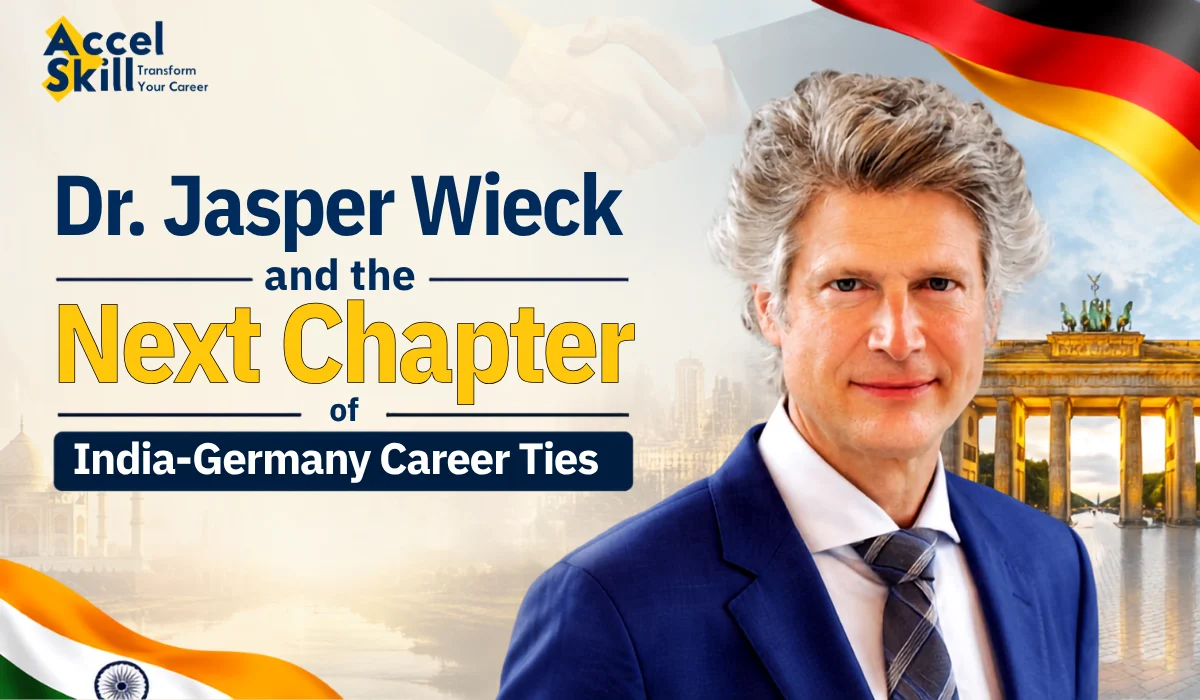
Dr. Jasper Wieck has a line he likes to use about India: coming here, he says, feels like coming home. It's not the kind of thing diplomats usually say in their first week on the job, but then Wieck isn't quite arriving as a stranger. He first set foot in India roughly 35 years ago, as a student, long before postings, protocol and position papers entered the picture. He came back years later as Deputy Head of the German Embassy in New Delhi, this time with his wife, Cordula, in tow. So when he took up his new role as Germany's Ambassador-designate to India and Bhutan in August 2026 and told reporters he considers himself an "old friend of India," it read less like a diplomatic flourish and more like someone picking up a conversation he'd left unfinished.
That personal thread matters here for a reason that goes beyond biography. Wieck's arrival lands at a moment when India and Germany are actively deepening cooperation on skilled migration, vocational training and language education — the very areas that shape whether an Indian student, nurse, technician or engineer can actually build a career in Germany. This piece looks at both: who Wieck is, and what the broader India-Germany Career Ties might mean for people weighing Germany as a destination for training, education or work.
Wieck is, by training, a historian. He studied in Bonn and Paris, and completed a doctorate in 1995 on France's response to the Manchurian Crisis of the early 1930s — an academic path that sits somewhat apart from the security and defence roles he'd go on to hold. He joined Germany's foreign service in the mid-1990s and spent the following three decades moving between some of the more consequential desks in German foreign policy: heading the Security Policy section at Germany's NATO mission in Brussels, then leading the Security and Defence Policy division at the Federal Foreign Office in Berlin. Between 2021 and 2022 he served as the Federal Government's Special Representative for Afghanistan and Pakistan, a role that put him squarely in South Asia-adjacent diplomacy, before becoming Political Director at the Federal Ministry of Defence from 2022 to 2026.
He succeeds Dr. Philipp Ackermann as Ambassador to India and Bhutan — worth noting simply because the two shouldn't be conflated; their tenures, priorities and public statements are distinct. Since his appointment was announced, Wieck has described his intended approach to the role in a phrase that's since circulated in Indian media: he wants to act as a "matchmaker, enabler and catalyst" for the relationship. It's a useful phrase, not because it announces any specific new programme, but because it captures the kind of connective, facilitation-oriented diplomacy the moment seems to call for.
Wieck's posting isn't happening in isolation. It follows Chancellor Friedrich Merz's visit to India in January 2026, after which both governments issued a joint statement laying out an unusually detailed agenda for cooperation — one that goes well beyond trade and defence into the mechanics of skilled mobility itself. The statement points to collaboration across skilled migration, vocational training, higher education, German-language teaching, healthcare talent, renewable-energy skilling, semiconductors, artificial intelligence, digitalisation, advanced manufacturing and the integration of Indian students and graduates into German institutions and workplaces.
Some concrete threads have emerged from this: a Joint Declaration of Intent on a Global Skills Partnership with specific relevance to healthcare professionals, plans for an Indo-German Centre of Excellence for Skilling in Renewable Energy, an expansion of German-language teaching across Indian schools, universities and vocational centres, and closer links between Indian Institutes of Technology and German technical universities. Skilled migration itself continues under the existing India-Germany Migration and Mobility Partnership Agreement.
It's worth being precise here: these are bilateral government priorities, not initiatives that Ambassador Wieck personally created. His role, as he's described it, is closer to helping steward and accelerate a relationship whose broad direction was already set before he arrived. At a German-Indian forum in June 2026, he was reported to have spoken about the direction of bilateral ties across trade, semiconductors, AI, advanced manufacturing and healthcare innovation — themes that align with, rather than originate, the wider agenda and the growing India-Germany Career Ties.
For Indian students, healthcare workers, engineers and vocational learners, the practical question is simpler than the diplomacy: does any of this translate into real opportunity? The honest answer is that the direction is favourable, but nothing here amounts to a guarantee.
Germany's ageing workforce and its stated interest in healthcare professionals, renewable-energy technicians, semiconductor specialists and AI talent suggest genuine demand in these areas. The bilateral agreements are designed to make it somewhat easier to navigate — through clearer skills-recognition pathways, expanded language training and closer institutional links. But none of these frameworks bypass the fundamentals: individual eligibility, language proficiency, documentation, employer demand and Germany's own immigration procedures still determine outcomes on a case-by-case basis. Both governments have been reasonably careful, in their public statements, not to frame this as an open door — and readers should be equally careful not to read it that way either.
One term that comes up often in this conversation is Ausbildung, Germany's dual vocational training system. It's worth explaining plainly, because it's frequently misunderstood in India as either a shortcut to a German job or a lesser version of a university degree — it's neither.
Ausbildung combines structured classroom instruction with hands-on training at a workplace, typically over two to three-and-a-half years, depending on the occupation. Trainees split their time between a vocational school and an employer, earning a modest wage while they learn a trade — anything from nursing and mechatronics to hospitality and IT. It's a genuinely different model from a conventional degree, built around practical competence rather than purely academic study, and it's taken seriously across German industry.
What it is not is a guaranteed route into a German job. Securing a training contract, meeting the language bar for the specific occupation, having documentation in order, and finding an employer with actual demand all have to align — and Germany's own immigration system, including specific visa categories for vocational training and for seeking a training place, has its own conditions. A candidate pursuing nursing will face a different set of expectations than one pursuing an engineering trade. Anyone exploring Ausbildung should go in expecting a structured, demanding process — not an easy shortcut.
It's tempting to treat a German-language certificate as a box to check before departure. In practice, language plays a far more functional role than that. Inside a classroom, it determines whether a trainee can actually follow instruction and participate rather than sit on the sidelines. On a factory floor or in a hospital ward, it can be the difference between correctly understanding a safety instruction and missing it. In daily professional life, it shapes how well someone can communicate with colleagues, supervisors and patients, and how smoothly they settle into life in Germany more broadly.
This is presumably why the bilateral agenda gives specific attention to expanding German-language teaching in Indian schools, universities and vocational education centres — language capacity is treated as infrastructure, not an afterthought. That said, there's no single, universal benchmark that applies across every pathway; the bar an aspiring nurse needs to clear looks different from what's expected of an engineering trainee or a graduate student. Prospective candidates need to check the specific requirement for their intended route rather than assume one certificate covers everything.
Strip away the diplomacy and the policy language, and what determines whether someone actually builds a career in Germany comes down to a handful of unglamorous basics: an honest assessment of one's existing skills against what a specific occupation demands, genuine language readiness rather than a passed exam, documentation that's been properly compiled and verified, some understanding of German workplace culture, and a clear sense of timelines rather than assumptions about how the process works.
This is also where things can go wrong for candidates who move too fast, or who rely on intermediaries promising outcomes that no legitimate pathway can guarantee. Sound preparation looks like transparent counselling, proper skills assessment, structured language training, careful documentation, and — perhaps most importantly — expectations set early rather than corrected late.
This is the layer where an organisation like Accel Skill has a role to play — not as a recruiter promising German jobs, visas or Ausbildung placements, none of which any training organisation can legitimately guarantee, but as a guide through the groundwork. That means helping candidates understand what different pathways to Germany actually involve, supporting German-language learning suited to a candidate's intended field, and encouraging people to approach international opportunities with a clear-eyed view of what's required rather than a shortcut mindset.
As the India-Germany Career Ties relationship continues to formalise cooperation on skilled migration, vocational training and language education, the gap that remains is at the individual level — and that's the gap organisations like Accel Skill are positioned to help close, provided they do so honestly.
Continue exploring topics that interest you.

