Business

For a lot of young people in Uttarakhand, the idea of working abroad has always felt like something that happens to other people — candidates from bigger cities, with better connections, better information, or just better luck. Skilled youth here often have the training and the willingness to relocate, but not always a clear, trustworthy channel to actually get there.
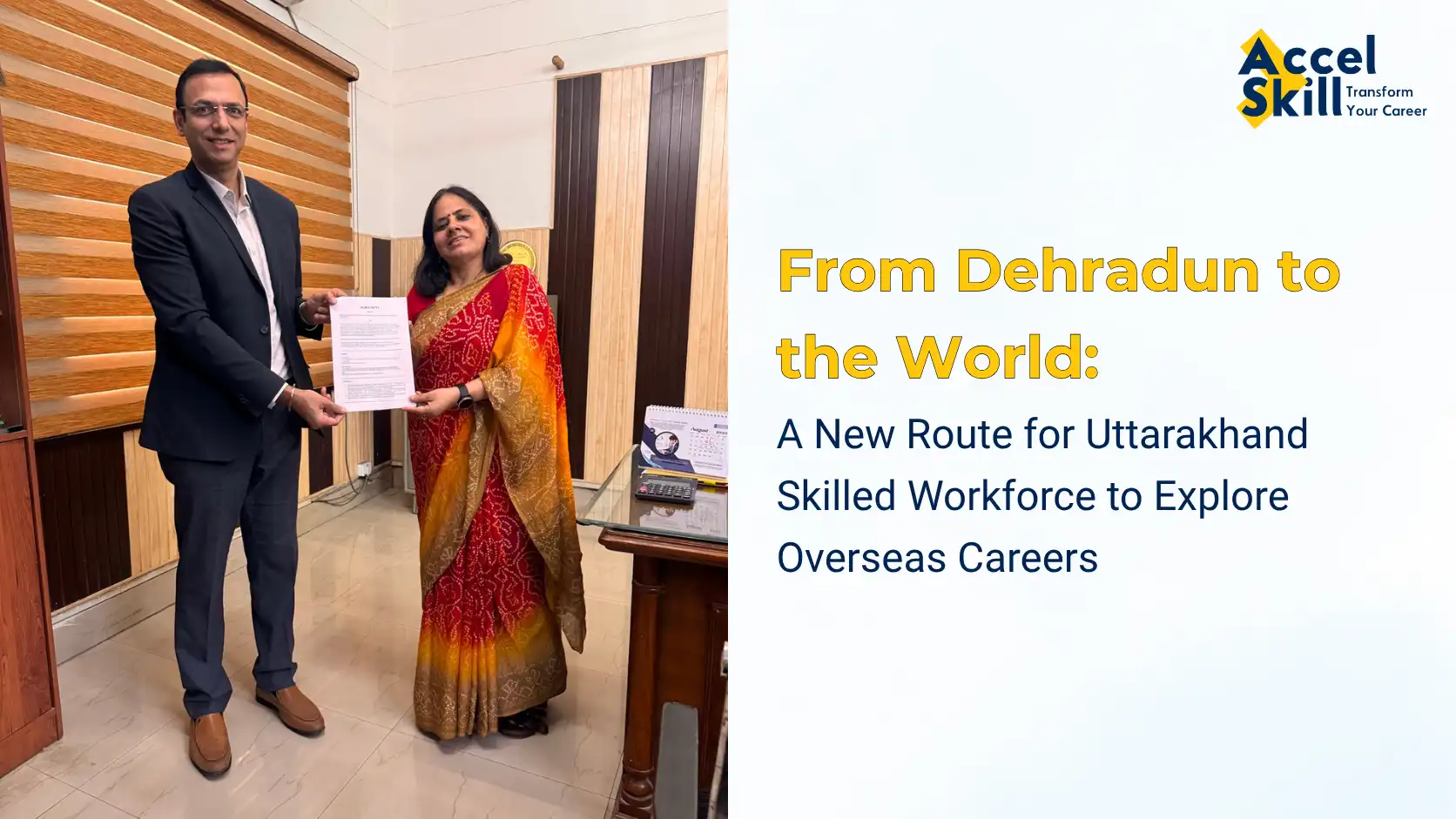
That gap is what the new collaboration between the Overseas Placement Cell (OPC) under the Department of Skill Development and Employment, Government of Uttarakhand, and Accel Skill Edutech Pvt. Ltd. is meant to address. Accel Skill is a recruiting agency registered with the Ministry of External Affairs (MEA), and under this agreement, the two organisations will work together to screen, train, and place eligible candidates from Uttarakhand into overseas employment opportunities. For the Uttarakhand Skilled Workforce, this creates a more structured route to explore international employment.
It's worth being upfront about what this is and isn't. This is not a guarantee of a job or a visa for anyone who signs up. It's a structured framework — one that lays out who does what, so that candidates moving abroad for work have some institutional backing behind them, rather than navigating the process alone.
Overseas recruitment has a reputation problem, and not without reason. Reports of fraudulent job offers, exploitative agents, and candidates left stranded abroad are common enough that many families are, understandably, cautious about the whole idea of working overseas.
This agreement tries to address that by putting a government body and a licensed recruiting agency on the same page, with defined responsibilities on both sides. The Overseas Placement Cell exists specifically to create awareness and facilitate overseas placement opportunities for Uttarakhand youth, and Accel Skill's role is to bring its MEA registration and recruitment experience into that process. Together, the aim is to give candidates a pathway that's easier to trust — one where vacancies are verified, training is organised, and there's someone to turn to if something goes wrong after arrival.
The agreement isn't limited to one industry. It covers eligible candidates for overseas employment opportunities across a fairly wide set of sectors, including nurses and care workers, hospitality roles in hotels and accommodation, restaurant and kitchen staff, food manufacturing, building cleaning management, security personnel, agriculture, and construction. These opportunities can help the Uttarakhand Skilled Workforce explore roles across different industries based on employer requirements.
The listed destination countries and regions include Europe, the UAE, Mauritius, Saudi Arabia, Poland, Russia, Ukraine, and Israel. Actual placements will depend on employer requirements at any given time — this is a framework for facilitating opportunities as they arise, not a fixed batch of jobs waiting to be filled.
Under the agreement, the Overseas Placement Cell takes on several specific responsibilities. It will publicise overseas job vacancies that come in through recruiting agents, using appropriate communication and media channels so that information reaches candidates across the state rather than staying concentrated in a few areas.
It's also responsible for identifying and mobilising potential candidates from different regions of Uttarakhand, and — where a role requires it — organising training programs in a timely manner. Before anyone leaves the country, the OPC is responsible for ensuring candidates go through Pre-Departure Orientation Training (PDOT), so they have a realistic sense of what to expect. And the government's role doesn't end at departure: the agreement commits it to following up with overseas workers and helping address grievances, as part of protecting their welfare.
On its side, Accel Skill's obligations under the agreement are fairly detailed. As a condition of this partnership, the company has committed to strict compliance with all guidelines issued by the Ministry of External Affairs, and to not charging candidates any fees beyond what MEA regulations explicitly permit.
Before any vacancy is offered to candidates, Accel Skill is responsible for verifying that the overseas employer is genuine and reliable, and for providing a formal undertaking to the Overseas Placement Cell certifying that authenticity. From there, the company arranges candidate interviews — in person or over video call — and is responsible for placing candidates who clear the required prerequisites, which may include a language proficiency test and other eligibility criteria set by the employer.
Where employers don't already provide it, Accel Skill will also arrange travel, including international air tickets. Once candidates arrive abroad, the company is responsible for receiving them, providing on-arrival orientation, and offering support during their stay, along with ongoing grievance redressal. All visa and immigration-related processes are to be handled in strict compliance with MEA guidelines.
It's also worth noting what candidates themselves are expected to cover under the agreement: visa, immigration, and examination fees, and air tickets where the employer doesn't provide them, along with the costs of any training — technical, language, trade, certification, or orientation — required for the role.
For a candidate in Uttarakhand, the practical journey under this framework looks something like this. First comes eligibility — matching your skills and background to a vacancy that's been publicised through the OPC. If training is needed for that role, it gets organised. If a language proficiency test or other eligibility criteria apply, candidates need to clear those before an employer will consider them.
From there, interviews are arranged, either in person or over video call, and candidates who are selected go through Pre-Departure Orientation Training so they know what they're walking into. Once abroad, Accel Skill is responsible for receiving and orienting them, and there's a defined channel for raising problems if something doesn't go as expected.
None of this promises a job to everyone who applies. It's a pathway for candidates who meet the required eligibility criteria, subject to what employers are actually looking for at a given time. But having that pathway mapped out — with clear responsibilities on both the government and recruiting-agency side — is meaningfully different from figuring out overseas recruitment through word of mouth or unverified agents. For the Uttarakhand Skilled Workforce, that structure can make the process more organised and easier to understand.
A large part of what makes this agreement worth writing about is the compliance framework built into it, rather than just the list of sectors or countries. The agreement is explicit that if migrants run into problems abroad because of fraudulent employers, violations of international regulations, or unauthorised collection of money from candidates, the Government of Uttarakhand will not be held liable — and in such cases, the agreement with the recruiting agency stands terminated, with the government reserving the right to pursue legal and administrative action.
That clause matters because it puts the weight of accountability squarely on the recruiting agency's compliance with MEA rules — genuine employer verification, no unauthorised fees, and proper handling of visa and immigration formalities are not optional add-ons here; they're conditions the agreement is built around. For candidates and their families, that's a more concrete form of protection than a general promise of "support."
This agreement runs for three years from its effective date, with room for either party to extend it by mutual consent, or to end it early with a month's written notice. Over that period, the intention is for the Overseas Placement Cell and Accel Skill to keep working through this same process — publicising vacancies, mobilising and training candidates, arranging placements, and following up once people are settled into their roles abroad.
It won't change things overnight, and it isn't meant to. What it does offer is a defined, accountable route for eligible skilled youth from Uttarakhand to explore overseas employment opportunities, with clearer expectations at every step — from screening and training to placement and life after arrival. For a state that has no shortage of capable, motivated young workers, that kind of structure is a reasonable place to start for the Uttarakhand Skilled Workforce.