
Career Development

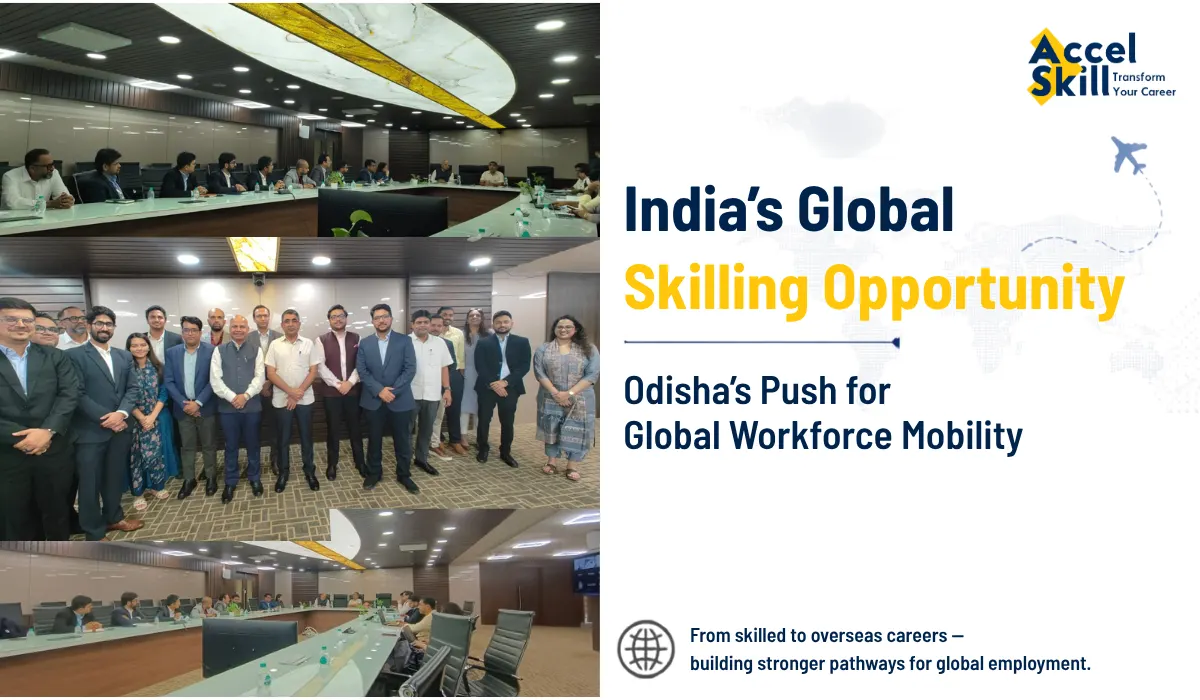
India skilling ecosystem is entering a phase where state governments and private industry are beginning to sit at the same table with a shared, narrow objective: turning trained candidates into placed candidates abroad. That was the spirit of the recent GSMI industry roundtable convened by the Department of Skill Development & Technical Education (SDTE), Government of Odisha, which brought together more than a dozen private-sector organisations working across recruitment, skilling, staffing and healthcare mobility — including Accel Skill — for a candid, first-of-its-kind conversation on skilling for global markets. The Odisha Global Skilling Roundtable highlighted the growing importance of coordinated efforts in building pathways for global employment.
Odisha participation was backed by scale, not just intent. The state has expanded its skilling budget 10–15x over the past decade and runs a flagship World Skill Centre, developed with ITE Singapore as its technical partner, with two more centres planned for its western and southern regions. Last year, the state placed roughly 250 candidates overseas, including 18 in Japan and a smaller cohort in Singapore. Government representatives were direct about their priorities: placements are the only metric that ultimately matters, and mobility has to remain legal, transparent and trust-preserving, since any lapse risks setting the entire ecosystem back. The Odisha Global Skilling Roundtable reflected this focus on creating credible and sustainable global mobility pathways.
A recurring theme was the need to align what candidates are taught with what international employers actually require. Discussions centred on jointly reviewing ITI, polytechnic and World Skill Centre curricula against destination-market standards, with industry contributing to trainer upgradation so that graduates arrive job-ready rather than requiring extensive retraining abroad. This demand-led approach, rather than a generic one, was positioned as the difference between a talent pipeline that converts and one that stalls at the visa or interview stage.
Several corridors and sectors stood out as near-term priorities:
Germany's Ausbildung apprenticeship: emerged as the most compelling opportunity for 12th-pass and graduate candidates. The roughly 120-year-old paid apprenticeship model — recently opened to Indian candidates — combines 15 days of study with 15 days of paid work, leading to full-time roles after three years. German law requires companies to maintain a minimum share of trainees, making demand structurally durable across 300-plus domains including logistics, mechatronics, electronics and accountancy.
Healthcare and physiotherapy: were flagged as high-potential, if currently uneven, corridors. German nursing recruitment is going through a temporary slowdown tied to hospital reforms, expected to stabilise over the next year or so, while demand for physiotherapists is rising, supported by curriculum equivalency recognised under the India–Germany mobility partnership.
Skilled trades, mechatronics and construction: were discussed as sectors facing a genuine succession gap abroad, particularly among family-owned enterprises, alongside strong existing demand in Gulf markets for trades where Odisha already has geographic specialisation.
Corridors beyond Germany: Including Australia, New Zealand, Mauritius, Japan and others — were also discussed, each with distinct barriers, from visa cost to language requirements.
Two problems dominated the room's attention more than any formal agenda item: making skilling aspirational enough that strong students choose it rather than treat it as a fallback, and financing candidate mobility. Loan products meant for skilling are often not treated as usable by lenders for mobility purposes, and inconsistent approval standards were repeatedly cited as a bigger obstacle to placements than curriculum or capacity. Alongside this, participants noted that behavioural and cultural-adaptation training, and creating visible long-term growth pathways for candidates, are becoming as important as technical skill-building itself.
For organisations like Accel Skill , working across international education, vocational training, language preparation and overseas career pathways, this kind of engagement matters because it surfaces exactly where state infrastructure and private-sector delivery need to connect. Government training capacity and institutional platforms are necessary, but converting that capacity into successful overseas careers depends on the language readiness, employability preparation and market-specific guidance that industry partners bring. Forums like this create the operating structure for that collaboration to be less ad hoc and more systematic. This Odisha skilling initiative also demonstrates how public and private stakeholders can work together around the needs of global employers.
The Odisha roundtable is a useful marker of where India global skills mobility ecosystem is heading: state governments building real training infrastructure, private players bringing employer-facing expertise and placement discipline, and both sides increasingly willing to name the hard problems — financing, aspiration, and standards — rather than only the easy wins. As more states pursue similar engagement, the sector's task will be to match growing placement ambitions with equally rigorous preparation, so that global mobility for India skilled workforce remains sustainable, credible and genuinely beneficial to the candidates at its centre. The Odisha Global Skilling Roundtable also reflects the wider role of global skilling in Odisha in shaping India's talent mobility ecosystem.
Continue exploring topics that interest you.

